
#1: America's Most Trusted
Pause and Resume
Real Support, 7 Days a Week
Fastest Allowed by Law
No Hidden Fees

◉ 5 Simple Savings Tips For Rideshare & Delivery Drivers

Easy and proactive steps to real world savings, insurance discounts, and professional driver improvement.

In recent years, rideshare and delivery services, such as Uber, Lyft, DoorDash, and GrubHub, have become increasingly popular for their customers and as a second career. If you are a driver or plan to become one of these drivers, then we’ve got 5 easy tips to help you save money every month!

5 – It’s All About the Benjamins: Getting Insurance Discounts

Any driver is required to have auto insurance, but were you aware that your personal auto insurance policy does not necessarily shield you from liability for accidents and traffic tickets that occur whilst you are driving professionally! For this reason, many Uber drivers choose to acquire “rideshare” insurance, but those policies can get really expensive. That’s why, if you plan to work for a delivery or rideshare service, you should ask your auto insurance provider if the policy you have allows for a “Voluntary Driver improvement course” in exchange for an insurance discount. Many policyholders have that stipulation already in their policy just waiting to be applied for a nice little discount. If you are eligible, you can easily enroll in a driver improvement course to get that insurance discount and save money today.

4 – If I Could Turn Back Time: Fixing Your Driving Record

Maybe you want to be a driver, but you have an existing ticket on your record. Some states actually allow you to take a “points credit” course to retroactively remove the demerit points on your record that may be there due to past tickets. Plus, removing these points will very frequently improve and lower your current insurance premiums. Some states that offer points credit courses are Alaska, Nevada, New Jersey, and Virginia. For more details, contact trafficschoolonline-dev.plume.co.uk/ or call 800 800 3579.

3 – Stand By Your Plan: Make A Plan To Reduce Daily Expenses

Make A Plan To Reduce Daily Expenses Knowing when and where to drive will help you increase the fare potential during your shifts. Familiarizing yourself with the area you will be driving in will also reduce unnecessary driving and fuel expenditure between locations you may need to utilize during your shift, such as public restrooms and gas stations. Additionally, your plan should include affordable meal prep; put simply, that means you can prepare yourself a weeks worth of sandwiches in advance, for about the cost of a single fast food combo-meal. So save money by bringing snacks with you during your shift, and avoid excess spending on fast food.

2 – Papa’s got a brand-new bag: Special Discounts For Mature Drivers

Special Discounts For Mature Drivers It may not surprise you to learn that most frequent rideshare users are under the age of 30, you may be surprised to learn that, according to a poll conducted in 2017, 54% of Uber drivers are over the age of 50, with almost 25% over 60. It also may surprise you to learn that many insurance companies offer specific auto insurance discounts to senior drivers who pass a “mature driver improvement course”. So, if you are 55+ and looking for a way to reduce your insurance costs, a Mature Driver Course may just be for you.

1 – She Works Hard For The Money: Proactively Protecting Your License

As a professional driver you will be on the road more than the average driver, so your odds of being pulled over for a minor moving violation is substantially higher than that of the average motorist. Non-Criminal traffic tickets, such as rolling through a stop sign, or minor speeding infractions are the number 1 reason for car insurance to go up. Fortunately, most states have a way to prevent a traffic ticket from being seen by your auto insurance company. So if you get a ticket while driving, it’s best to be proactive and contact a traffic school ASAP, before your insurance company has a chance to ding you for it.

We hope this guide to traffic tickets, auto insurance discounts, and professional driver tips to save money has been helpful; so, if you have any other questions about driver improvement courses for insurance discounts, feel free to contact us.
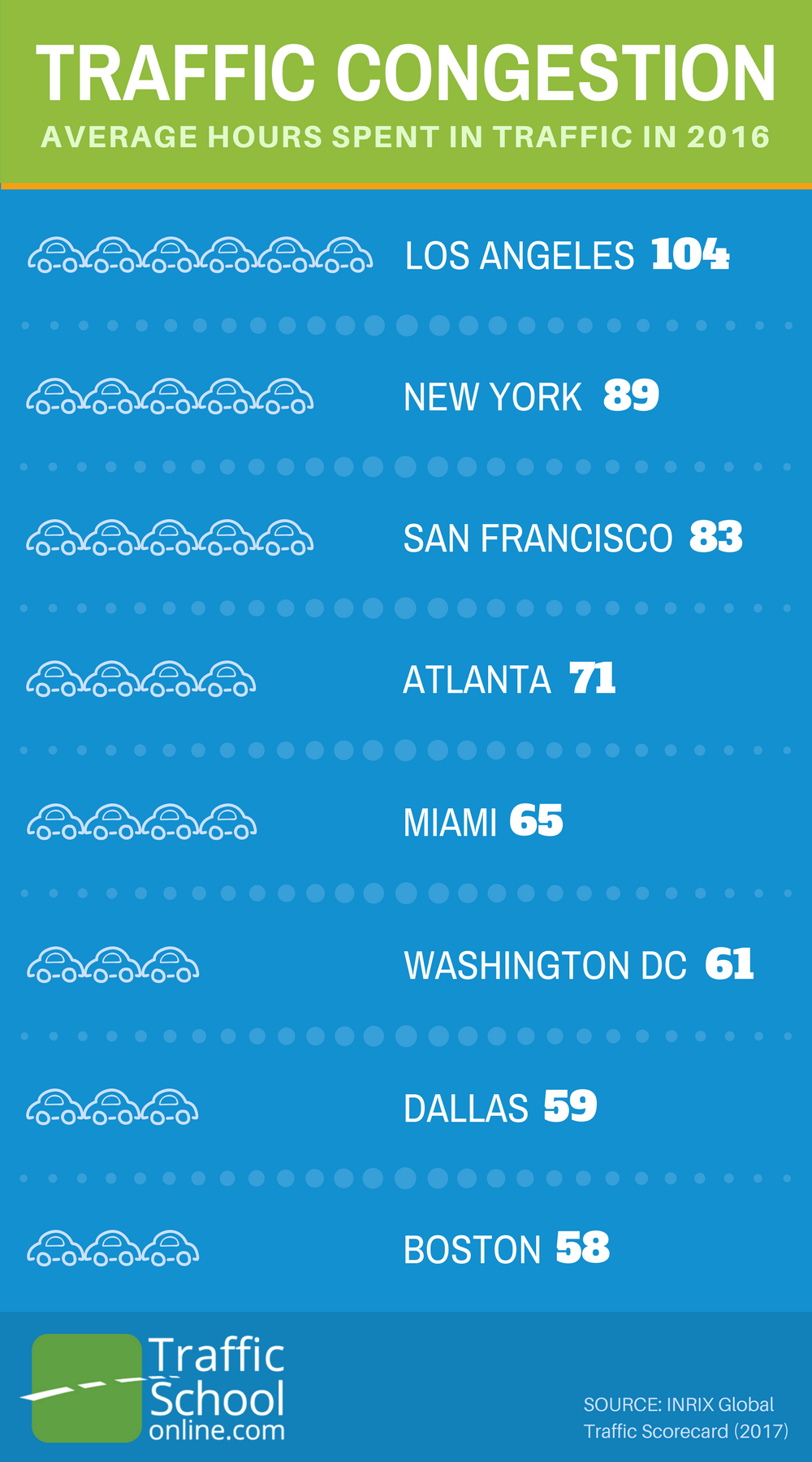
How does your city rank for traffic congestion? You might be surprised at the number of hours you spend stuck in traffic each year. The INRIX Global Traffic Scorecard has analyzed and ranked traffic congestion in 1,064 cities across 38 countries, in the largest ever study of its kind. Their aim was to determine both the financial impact of traffic congestion and the number of hours the average driver spends in traffic each year.

In this global study, 3 of the top 4 worst cities in the world for traffic were in the U.S., with Los Angeles coming in at the number 1 spot. They estimate that the financial cost of traffic congestion to the average Los Angeles Driver in 2016 was $2,408, totaling $9.7 billion for the entire city. Not to mention that on average, Angelenos each spent 104 hours sitting in traffic in 2016. New York, San Francisco, and Atlanta weren’t far behind, with 89, 83, and 71 hours respectively — each of these cities incurring upwards of $2.5 billion in costs relating to traffic congestion.

The study’s cost calculations involve the value of fuel and time wasted, as well as indirect costs of freight and company vehicles idling in traffic, which translate into higher prices for household goods.

Though the residents of these cities may spend a staggering amount of time stuck in traffic over a lifetime of commuting, and endure the associated financial costs, high levels of traffic congestion are an indication of a thriving economy. As lawmakers and private companies alike work to ease the gridlock and traffic congestion burdening drivers, progress is being made in the form of studies like this one, which provide insight into specific problem areas and budget prioritization. Understanding when and where congestion is worst, and exactly how bad it is, can be considered the first crucial step in solving the dilemma.

Though the research, diagnosis, and correction of these issues is a long and daunting task for government and transportation officials; there are things that every driver can do now to help reduce the effects of traffic congestion on their time and wallets. Simple strategies include taking advantage of carpooling to share expenses, or planning routes in advance to reduce time spent in traffic. You can use strategies to reduce other driving-related costs and reclaim some of the costs lost to traffic. Shopping insurance quotes regularly, taking safe driver courses to reduce insurance costs, and using fuel perks or reward cards can all help to negate the cost of traffic congestion and free up hundreds of extra dollars annually for drivers.


Traffic Congestion Infographic

trafficschoolonline-dev.plume.co.uk/

The pioneer in online driver improvement with over 1 million satisfied graduates … since 1998.

Find out more now!

Are you tired of feeling like you’re wasting valuable time and gas driving to school, work, or elsewhere on a daily basis? If so, then you might want to consider setting up a carpool. After all, with a carpool, you can share rides with others traveling to the same destination each day, saving yourself mileage on your car, gas money, and hassle. Still, organizing a carpool can be a bit of a challenge. By following these tips on how to organize a carpool, however, you’ll be on your way to success in no time.

Consider the Carpool Type

Start by considering what type of carpool would make your life easier. Two common types of carpools are school and work-related. For example, many busy parents set up a school carpool, where parents take turns each day of the week driving groups of children to and from school. On the other hand, even if you don’t have school-aged children, a work carpool could be a great way for you and your co-workers to save money on fuel as well as wear and tear on your cars. For those who have similar shifts, taking turns driving the group to work each day can be a great option.

Recruit Interested Drivers

Once you have an idea of what type of carpool is the best option, it’s time to start recruiting potential drivers who might be interested in participating. There are many ways to go about doing this. For example, you could simply spread the idea of your carpool by word of mouth by talking to some of your close friends at work or other parents at your child’s school.

For a workplace carpool, you might also consider posting a sign-up sheet or information sheet in the break room at your place of employment, encouraging interested drivers to leave their names and contact information. Social media is also an excellent way to spread the word about your carpool.

Regardless of how you recruit drivers for your carpool, make sure you obtain some specific information that’ll help in organizing the carpool schedule. This includes addresses, pick-up locations, and daily schedules for those involved.

Use a Carpool App

When it comes to officially organizing your carpool, there are several options. However, one of the best options is to use a carpool app, of which there are many available for those with Android and iPhones. Specifically, a carpool app will allow everybody who downloads the app and joins your carpool group to have up-to-date access to the carpool schedule, which helps you ensure that everybody stays in the loop.

Always Have a Backup Plan

From time to time, there are going to be some hiccups in your carpool plan. A child may get sick, a car may break down, or other commitments may come up. Regardless, it’s important for you as the carpool organizer to have a backup plan in place. Specifically, each carpool date should have at least one backup driver in the event that the primary driver cannot meet his or her obligations.

Make a Safety Commitment

Finally, you may also want to have your carpool participants sign some sort of agreement or safety commitment. For instance, participants may agree that all vehicles used in carpooling need to be well-maintained, and properly insured, and that drivers will exercise basic safety precautions during transport. This can help to ensure a safe ride for all involved in your daily carpool group.

With a little bit of planning and foresight, you can successfully organize a carpool group that saves people time, money, and hassle. For more tips on safe and responsible driving, why not enroll in an online traffic school?

In last week’s post, we looked at how Dallas, Las Vegas, and Los Angeles are handling traffic congestion by building new roads, implementing adaptive traffic signaling, and improving mass transit. Being stuck in traffic is a huge pain, but is avoiding it really worth these huge costs?

In a word – yes.

Traffic congestion itself is extremely expensive. As cars idle around the nation, we’re wasting an astonishing amount of time, fuel, and money. And the problem is only expected to increase as our population grows, employment increases and fuel prices remain high.

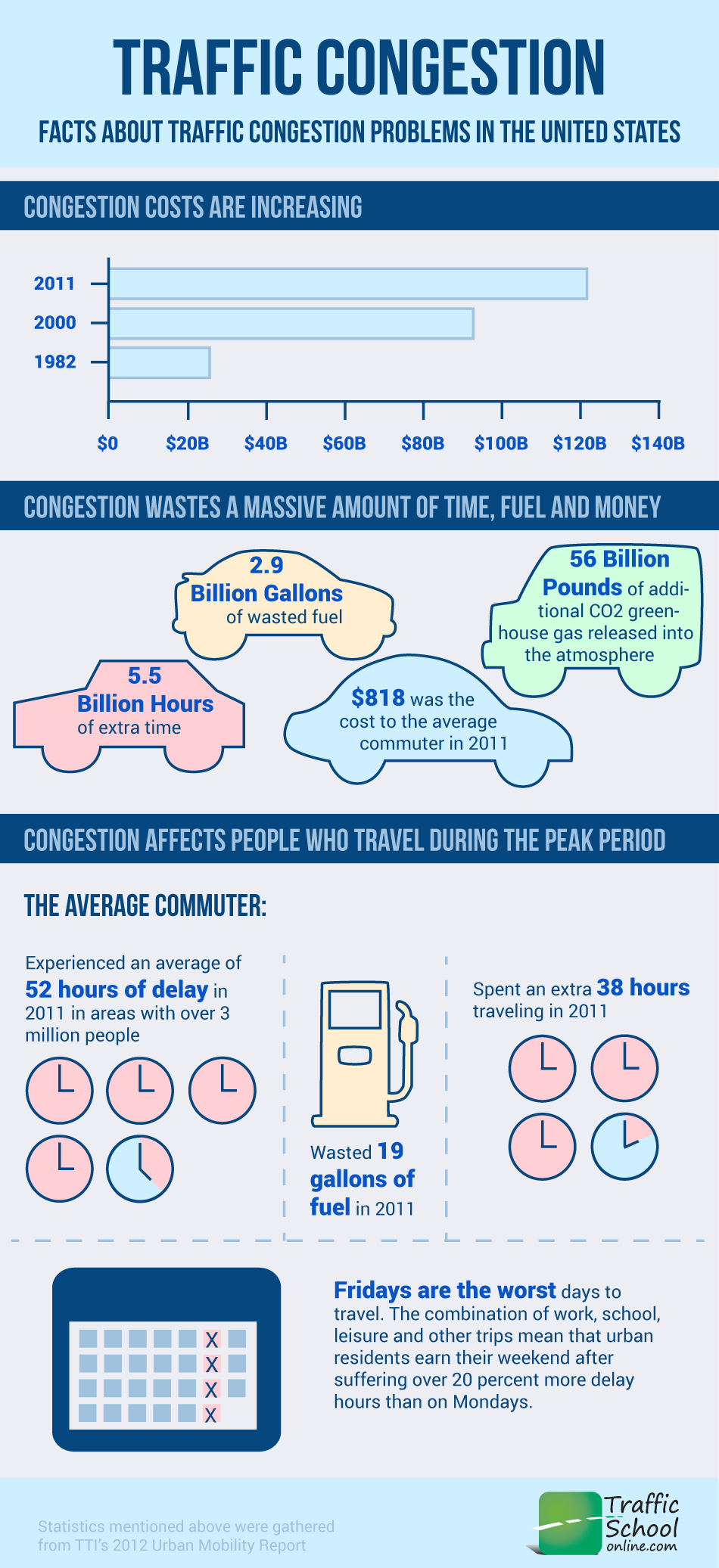
To find out what traffic congestion is costing us right now, check out the infographic below.

Click the infographic to view a larger version.

Traffic Congestion Infographic

Costs related to traffic congestion are increasing. In 2011, the costs were over $120 billion. Traffic congestion wastes a massive amount of time, fuel, and money. It wastes 5.5 billion hours of extra time and 2.9 billion gallons of fuel. The cost to the average commuter in 2011 was $818.

No matter where you drive, chances are you’re familiar with traffic congestion. Stop and go, bumper to bumper, gridlock, bottlenecks, rush hour… we have a wide vocabulary for describing the specific traffic situation that’s holding us up.

But unfortunately, the problem is bigger than we can see from our vantage point on the highway, and it’s not going away anytime soon. According to the 2012 Urban Mobility Report published by Texas A&M University, congestion levels are expected to increase beyond the peak reached in 2005, before the economic recession.

So what are transportation planners doing to manage the increasing number of drivers who want to use the overcrowded highway system?

PBS tackles this question in Nation on the Move, the second episode of their 2012 America Revealed series. The show focuses on three cities, each with a unique congestion situation, and a different approach to managing the problem.

Please note that the first portion of the episode covers rail and aviation, and the section on car traffic starts at 32:48.

Dallas, Texas

Highways between Dallas and Fort Worth, Texas fostered the creation of suburbs like Arlington and nearby Colleyville. As in many other areas of the country, these highways were designed to take suburban residents to jobs and stores in big cities. But now, people work and shop in the suburbs too, and barely travel into the city at all. At the same time, the area’s population has doubled, and the number of cars on the road has tripled.

The smaller secondary roads that exist within the suburbs weren’t designed to move these large numbers of cars, so these roads are being expanded, and new highways are being built to take suburban residents where they’re actually trying to go.

Las Vegas, Nevada

Las Vegas is a city of 2 million people which receives 36 million visitors per year. Rather than building new roads, transportation experts are monitoring traffic and adjusting the city’s 1,250 traffic signals to allocate “green time” as efficiently as possible and prevent too much traffic from backing up at intersections.

Los Angeles, California

Los Angeles, home to 12 million cars, doesn’t have “smart” roads like Las Vegas and has no room to build new roads, like Dallas. Instead, Metro transportation planners are looking to the past, hoping to revive the robust mass transit system that existed in the city before the 1940s. Old streetcar routes, previously abandoned in favor of bus lines and private cars, are now being reclaimed, rebuilt, and upgraded for modern light rail.